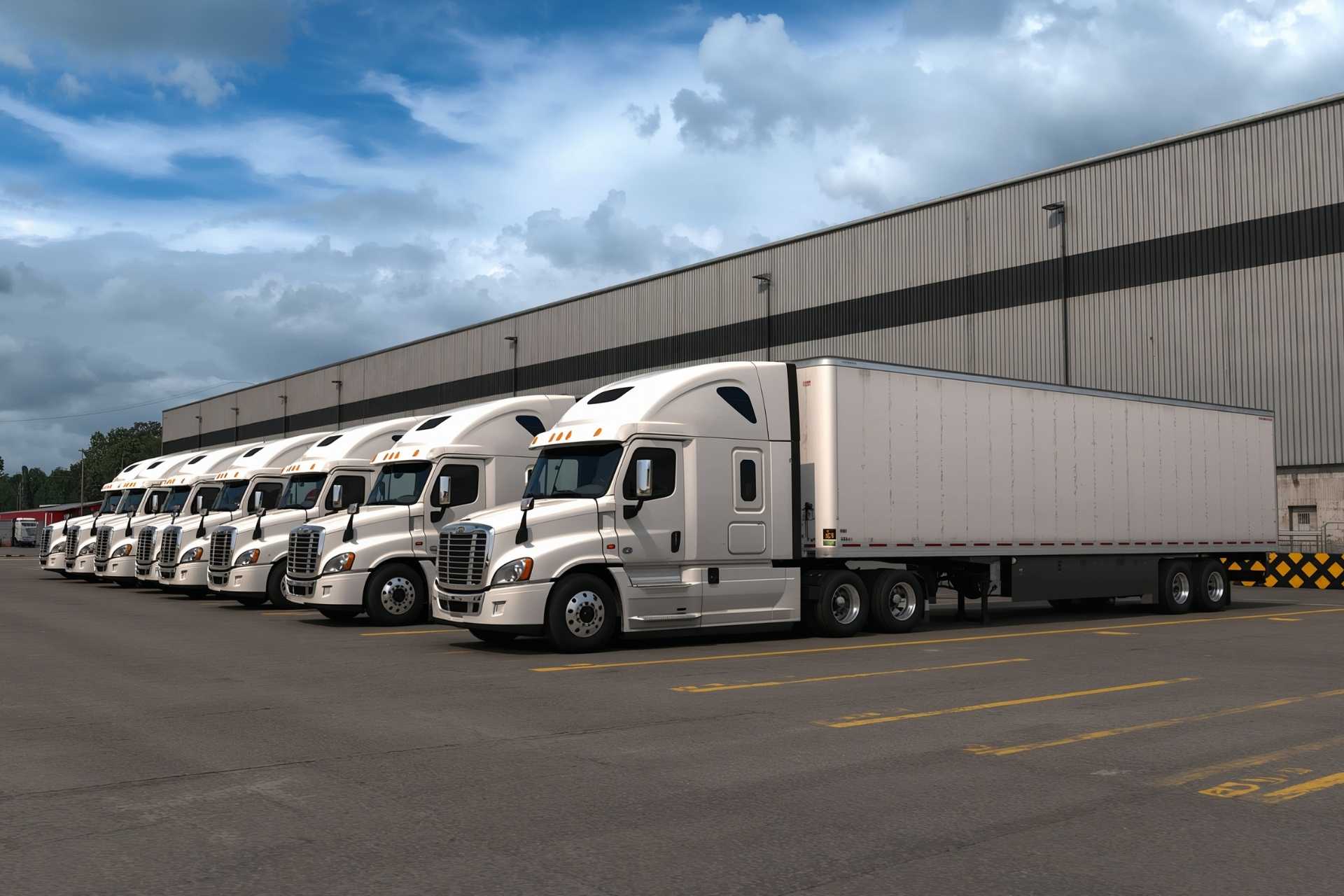
The four-year freight recession is turning in 2026 as capacity leaves faster than demand recovers.
For four years, trucking companies have lost money on almost every load. Spot rates fell below $2.30 a mile, more than 200,000 new carriers piled into the market during the pandemic boom, and margins stayed compressed long after the stimulus checks stopped. That cycle is turning, not because shippers suddenly need more freight moved, but because the excess capacity that caused the crash is finally leaving.
This guide covers the freight recession timeline, the 2026 rate and capacity data, why the recovery is supply-driven rather than demand-driven, and what it means if you sell into transport, logistics, manufacturing, or packaging right now.
The freight recession traces back to April 2022. Pandemic-era demand, cheap credit, and record-high spot rates pulled a wave of new operators into trucking. The number of for-hire carriers grew from about 241,000 in June 2020 to over 475,000 by July 2023. When freight demand normalized, that capacity did not leave fast enough, and rates collapsed under the weight of it. What followed became one of the longest downturns in trucking history, roughly three years of carriers running loads at a loss just to keep trucks moving.
The reversal is visible in the rate data, and it is a supply story, not a demand story. Shipment volumes were still down 4.5% year over year in March 2026, yet the average cost per shipment rose anyway, because there are fewer trucks left to move it. The national average truckload spot rate reached $2.96 per mile in March 2026, up more than 27% year over year, and rates on lanes over 250 miles climbed to $2.73 per mile, the highest level since 2022.
The Cass truckload linehaul index surged 5.6% year over year in April 2026, the largest annual jump since August 2022, and spot rates overall were up 25% year over year that same month, the fourth straight month of gains. Carrier exits are accelerating too. The exit rate in May 2026 ran 31% above the same period in 2025.
Three things are driving the shift, and none of them is a freight boom.
Carriers are exiting faster than at any point in the downturn. Net authority revocations were already 16% higher in the first half of 2025 than the same period in 2024. By May 2026, the exit rate was running 31% above 2025 levels. Analysts estimate 5,000 to 8,000 carriers effectively left the market in 2025 alone, and the carriers leaving now skew older and more established than the small operators that failed early in the downturn.
Equipment capacity is contracting alongside the labor pool. Fewer trucks are available at the same time driver availability is declining, a rare combination this late in a freight cycle. That pairing is why rates are climbing even as volumes stay soft.
Weather and tariffs are adding short-term volatility on top of the structural trend. Severe winter weather tightened networks earlier in 2026, and new tariff developments in February 2026 introduced fresh uncertainty into the recovery timeline. Neither is the root cause, but both are accelerating the squeeze.
Spot rates move first because they reprice load by load, while contract rates are locked in for months at a time and adjust slowly as those contracts come up for renewal. Spot truckload rates have been rising for four straight months and are now approaching contract rates, a signal that has historically preceded a broader rate cycle turn. It will still take time for that pressure to fully show up in contract pricing, which is why most analysts describe a U-shaped recovery rather than a sharp rebound, with the downturn possibly declared over by Q2 or Q3 2026 if capacity keeps contracting and demand improves gradually.
A market where capacity is shrinking and pricing power is returning is exactly the moment relationships shift. Shippers who spent four years leaning on soft rates and abundant capacity are about to face a very different negotiating table, and they will be looking for new carrier and broker relationships before their existing ones get too expensive or too full.
That is also true in reverse. Carriers and brokers who survived the shakeout now have room to go after freight they could not compete for during the downturn, but only if they can identify which shippers are actively moving volume and which importers are ramping up before their competitors do.
This is where trade and shipment data stops being a nice-to-have. Knowing which companies are actually importing, what they are moving, and how their volumes are trending gives a logistics sales team a real head start in a market that is about to reprice. If your team is also managing the operational side, our guide to the best TMS software for logistics companies and our CargoWise alternatives comparison cover the systems most freight forwarders and brokers are evaluating alongside this shift.
Ubico turns 70M+ global shipment records into a list of the importers, exporters, and shippers that match your lanes, refreshed daily, so you can see real import and export activity, carriers, trade lanes, and volumes before the recovery is common knowledge. It also runs the outreach, so a lead you spot in the data turns into a conversation without a separate tool.
See how logistics companies use Ubico to find new shippers.
New to the terminology? Our logistics glossary breaks down the key terms.
Is the freight recession over in 2026? Not officially declared over, but conditions have turned. Spot rates are up 25% year over year as of April 2026 and carriers are exiting at the fastest pace of the downturn. Most analysts expect an official end to be called by Q2 or Q3 2026 if the trend holds.
When did the freight recession start? The current freight recession began in April 2022, after a pandemic-era freight boom drew a wave of new carriers into the market and then demand normalized faster than that capacity could exit.
Why are freight rates going up if shipment volumes are still down? Because the recovery is supply-driven, not demand-driven. Shipment volumes were down 4.5% year over year in March 2026, but so many carriers have left the market that the remaining capacity can charge more for the same freight.
Why are so many trucking companies going out of business in 2026? Four years of rates below operating cost finally caught up with carriers that were running on thin margins or debt. The carrier exit rate in May 2026 was 31% above the same period in 2025, and the carriers leaving now are older and more established than the small operators that failed earlier in the downturn.
How long do freight recessions usually last? This one has already lasted about four years, making it one of the longest in trucking history. Most freight cycles are shorter, but the scale of pandemic-era overcapacity made this correction unusually slow.
What should logistics companies do while the market is turning? Shippers should expect to renegotiate contract rates as capacity tightens, and carriers and brokers should prioritize identifying shippers with growing import and export volumes now, before competitors reach them once the recovery becomes obvious.
See how Ubico can help your team prospect, enrich, and engage.